

New resources support inclusive and sustained employment after brain or spinal cord injury
The Hopkins Centre is pleased to share two new evidence-informed guides designed to support sustained employment following acquired brain injury (ABI) or spinal cord injury (SCI), developed through a Seed Grant research project led by Dr Jessie Mitchell.
The project, Sustained employment following acquired brain or spinal cord injury: Case studies involving employees, employers, and service providers, explored how people with ABI or SCI successfully sustain work with the same employer for 12 months or longer and what helps make this possible.
Turning lived experience into practical resources 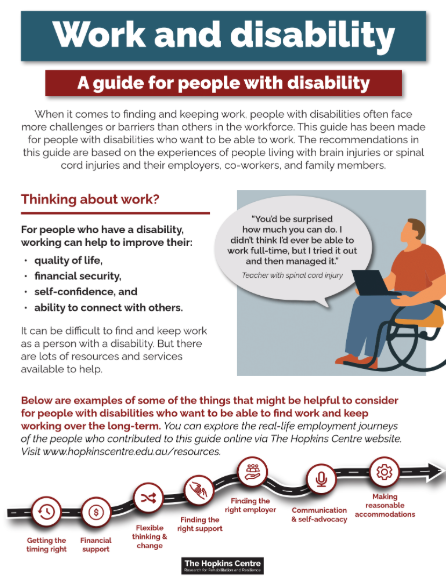
People who experience ABI or SCI often face significant barriers when returning to work, finding new employment, or maintaining long-term roles. While some people do return to work post-injury, research shows that job withdrawal is common and many leave the workforce earlier than planned.
This project sought to better understand what does work — by learning directly from people with ABI or SCI who have sustained employment, as well as from their employers, co-workers, rehabilitation clinicians, and employment service providers. The research examined personal, injury-related, and workplace factors that contribute to successful, sustained employment.
Two new guides now available
Insights from the research informed the development of two practical recommendation guides:
Sustainable Employment Guide – People with Disability
This guide is designed for people with disability who want to find, return to, or sustain work. It includes lived-experience insights, practical strategies, and considerations around self-advocacy, workplace adjustments, support services, and career flexibility.
Inclusive Workplaces Guide – Employers & Co-Workers
This guide supports employers and teams to create inclusive workplaces that value diversity, promote retention, and support employees with disability. It offers practical guidance on inclusive recruitment, communication, reasonable adjustments, and return-to-work support.
Both guides are grounded in case studies and personal employment stories from people who have successfully sustained work following ABI or SCI.
Sharing impact through events and presentations
Project findings have been shared through multiple knowledge-exchange activities, including:
- Hopkins Hour (27 March 2025) – Pathways to inclusive and sustainable employment
- BIBS24 Symposium presentation on sustained employment following ABI or SCI.
These activities highlight the importance of inclusive employment practices and the value of learning directly from lived experience.
Research team
Chief Investigator:
Dr Jessie Mitchell
Project investigators:
Dr Vanette McLennan; Dr Kerrin Watter; Dr Emily Bray; Associate Professor Melissa Kendall; Dr Christy Hogan; Ms Janelle Griffin; Dr Delena Amsters; Mr Michael Dobbie-Bridges PLY; Ms Belinda McLeod; Mr Timothy Matthews; Dr Knut Jan Schneider; Professor Tamara Ownsworth; Professor Timothy Geraghty.
Explore the resources
The guides, along with personal employment stories and journey maps, are available via the project website and are intended for people with disability, employers, co-workers, and professionals seeking practical, research-informed strategies to support inclusive and sustainable employment.
Tags: Employment, Seed Grant, Brain Injury, Spinal Cord Injury
Related Articles
- World-leading centre for rehabilitation and disability research opens
- Improving the ability of employers to communicate with brain injured workers
- Making breathing easier for patients with acute spinal cord injury
- Singing as a form of rehabilitation
- 2019 THC Seed Grant and Fellowship recipients!
