

SEED PROJECT: Making interdisciplinary pain management programs more patient-centred: a qualitative study of patients' perceptions of the ENGAGE pain group
About the Project
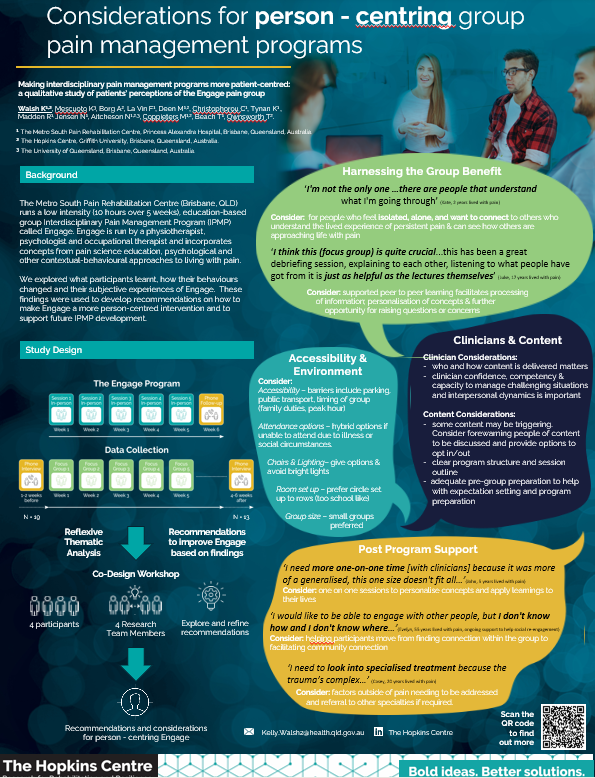
Led by MSPRC physiotherapist Kelly Walsh, this project aims to explore the knowledge and skills people with chronic pain acquire from participating in ENGAGE, an interdisciplinary pain management program to inform more patient-centred model of pain management.
Project aims
This project aims to explore patient learnings, experiences and changes in behaviours that occur during and following an Interdisciplinary Pain Management Program (IPMP). Little is currently known about what patients actually learn from IPMPs and the impact this has on patient outcomes. Knowledge and skills acquired from participating in ENGAGE program, will inform a novel patient-centred model of pain management that identifies mechanisms of change specific to IPMPs.
Expected outcomes
Expected outcomes and research recommendations will support consumer-focused redesign of IPMPs, ensuring IPMPs are more responsive and relevant to consumers. These recommendations could improve patient outcomes and the utility of pain services.
Knowledge will also be disseminated to a wider audience and translated into improved clinical practice within IPMPs. This research provides a strong foundation for future studies into patient perceptions from IPMPs, how this influence outcomes, the efficacy of IPMPs incorporating pain education with acceptance and commitment therapy, and underpinning behaviour change.
Project outcomes and impact
- Changes to Allied Health Pathways – CONNECT group
The CONNECT group was established in response to participants feeling isolated and alone in their pain experience. Participants attend CONNECT after seeing the pain specialist and before seeing Allied Health. The group provides a bridge between medical and allied health approaches to pain rehabilitation, offering a supportive place to learn how allied health and other MSPRC services may assist in their pain journey. It also aims to help participants feel safe in a group environment and to recognise that they are not alone – that others understand how pain has affected their lives. CONNECT also offers a sense of shared understanding to people who may not go on to attend Engage. After attending CONNECT, participants are supported to choose the pathway that best fits their pain rehabilitation needs, helping to foster greater autonomy.
- Improved Pre-Engage preparation for participants
This enhancement was introduced in response to participants reporting that they felt inadequately prepared for Engage, and in recognition of the importance of ensuring people feel safe and supported when attending the clinic. The updated preparation now includes:
- New information sheet providing a clear overview of the program structure and session outline.
- Pre-Engage phone consultation to set expectations, offer further detail about the purpose and content of Engage, and address any questions participants may have.
- Post Engage session “coffee and chat”, facilitated by a nurse at MSPRC.
This initiative was introduced in response to research participants expressing that the Focus Group component was just as valuable as the program itself. Feedback has been consistently positive, with participants appreciating the opportunity to further explore concepts discussed during the group. The session also provides a supportive platform where participants can learn from one another, share experiences, and offer mutual encouragement.
- Redesign of Engage content to prioritise the elements participants identified as most beneficial. In addition, we have adopted a more trauma aware approach to how sessions are delivered.
- Hybrid options for selected groups
In response to participants reporting difficulties attending in person due to factors such as location, timing, or illness, hybrid delivery options have been introduced for some groups. These currently include the sleep group and the flare up workshop. This is also being looked at for some Engage sessions if participants are unable to make it in person.
- Post-Engage groups
In response to participants expressing the need for ongoing support in their pain journey, several new groups have been established. These include tai chi, yoga, flare-up workshop, sleep group and a psychological skills short course. Together, these offerings aim to build on concepts introduced during Engage and provide continued support as participants implement the skills they have learned.
- Community Immersion Activity
In response to participants expressing challenges with reconnecting with the community, MSPRC will offer 2–4 community immersion activities each year. Each activity involves two MSPRC clinicians meeting participants at public‑transport–accessible locations, such as GOMA. Participants will be assisted in navigating barriers to attending, such as catching public transport (e.g., how to pay, route planning). One immersion activity has been held so far, with very positive participant feedback.
- Clinician Impact
The Engage research project has given us valuable insight into our patient cohort, elements of the group that can be strengthened and how we, as clinicians, can better facilitate outcomes. We have incorporated language that emerged from the research, such as “the pain puzzle”, explicitly highlight aspects of the group that participants found most beneficial, such as realising they were not alone in the pain experience, and have become more responsive to participants needs and preferences around how and when content is presented. We have become more understanding of the challenges our patients face and have been more proactive in providing post program support to patients completing Engage (either individual or groups).
Research presentations:
- Hopkins Hour, July 2025
- QLD Persistent Pain Physiotherapy Network presentation, August 2025
- Bold Ideas Better Solutions Symposium, September 2025
- Metro South Pain Rehabilitation Centre Inservice, October 2025
- Sunshine Coast Persistent Pain Management Service Presentation, April 2026
- Australian Pain Society Annual Scientific Meeting, Poster Presentation, April 2026
- Presented research poster at the PAH Symposium August 2026. View poster here
- Presented to Health Improvement Community of Practice (HICOP) network October 2026.
Project team
Kelly Walsh, Senior Physiotherapist, Metro South Pain Rehabilitation Centre
Nicholas Aitcheson, Rehabilitation and Pain Medicine Specialist, Metro South Pain Rehabilitation Centre
View All Researchers

