

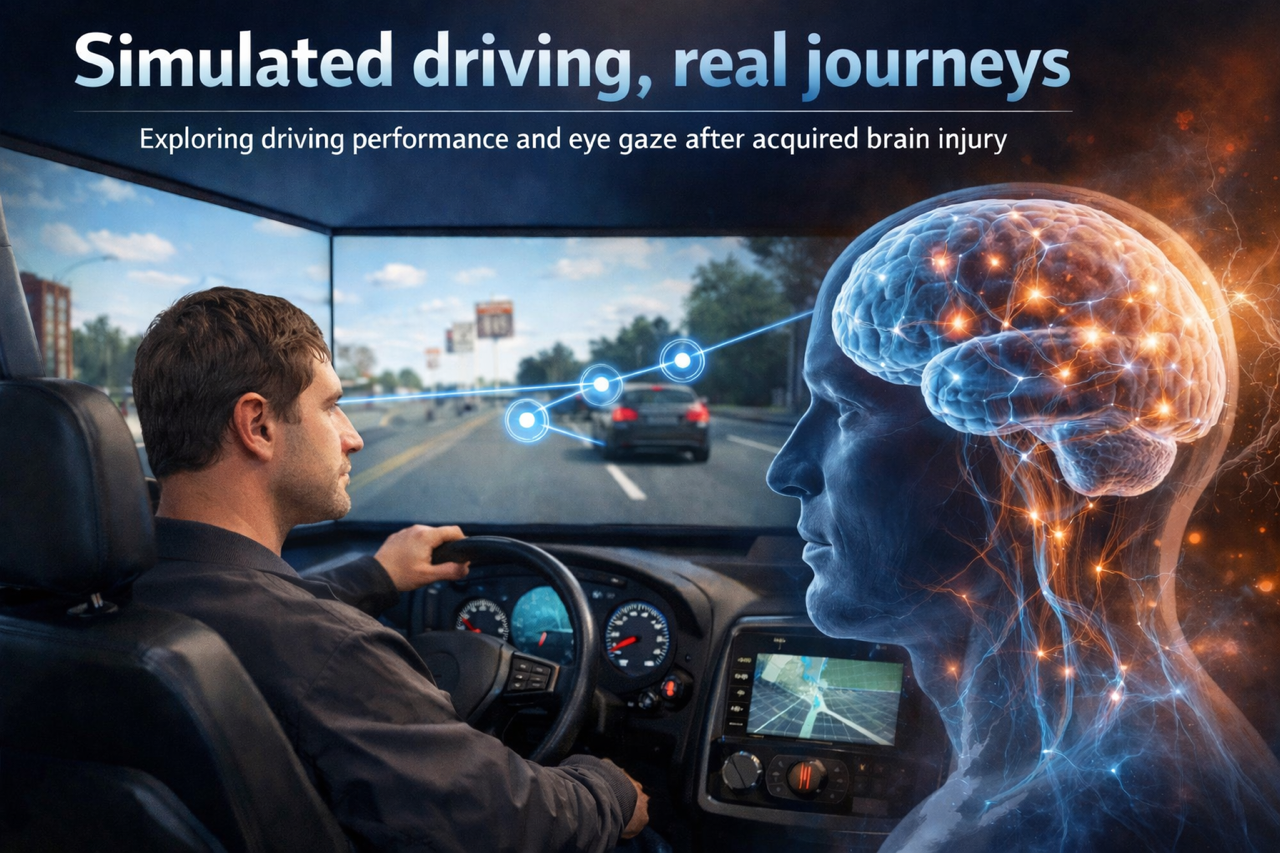
SEED PROJECT: Simulated driving, real journeys: Exploring driving performance and gaze behaviour following acquired brain injury
About the Project
Researcher name: Dr Louise Bassingthwaighte (Chief Investigator), School of Allied Health, Sport and Social Work and The Hopkins Centre, Griffith University
People/organisations involved:
Griffith University – School of Allied Health, Sport and Social Work (Louise Bassingthwaighte, Chris Irwin)
Griffith University – School of Applied Psychology (Darren Wishart, Matthew Stainer)
Metro South Health – Occupational Therapy (Janelle Griffin)
Gold Coast University Hospital – Allied Health, Rehabilitation (Sarah Grounds, Hannah Carey)
The Hopkins Centre (Jayke Bennett, Louise Gustafsson)
Lived experience expert (Clive Kempson)
Driving is a valued goal for many people following acquired brain injury (ABI) as it supports choice and independence with community-based participation and reduces isolation and depressive symptomatology. However, driving is a complex occupation requiring effective integration of visual, cognitive, motor, and behavioural skills within dynamic and unpredictable environments. ABI-related changes can affect these domains, reducing driving competence and safety. Differences in on-road driving performance have been noted between those who return to driving post-ABI and those who do not, in areas such as observation and awareness of driving environment, speed control, planning and judgement, and self-navigation. Yet clear understanding of factors underpinning differences in driver performance and optimal remediation strategies remain unclear.
Aim and objective
The study has three aims:
- To compare simulated driving performance across people with ABI who aspire to return to driving (Rehabilitation) to people with ABI who have successfully returned to driving (Returned), and people without an ABI (Control).
- To evaluate gaze behaviours during simulated driving across Rehabilitation, Returned and Control groups to identify gaze allocation and cognitive skills which may be critical for driving remediation.
- To explore the feasibility of using a simulator for driver remediation following an ABI, particularly focussed on the attitudes and acceptability of the modality for Returned and Rehabilitation groups.
Expected outcomes and impact
- We hypothesise:
People with ABI who have not yet returned to driving (Rehabilitation) perform worse on speed control, lane position, driving decisions (e.g., at traffic stops, roundabouts), self-navigation, safe distance (i.e., headway), and response latency (speed to react) as compared to people with ABI who have successfully returned to driving (Returned), and people without an ABI (Control). - The Rehabilitation perform more fixations, of shorter duration, have reduced visual scanning when driving (i.e., across horizontal axis), and will spent less time checking mirrors and driver related information (e.g., instrument cluster), compared to Returned and Control.
Findings arising from this project may benefit individuals looking to return to driving post-ABI, their support networks, professionals supporting return to driving goals (e.g. multidisciplinary healthcare team, occupational therapists with qualifications in driver assessment and rehabilitation, driving instructors), and organisations funding rehabilitation (e.g. National Injury Insurance Scheme, National Disability Insurance Scheme) by increasing understanding of simulated driving performance and views of people concerning the use of driving simulator following ABI. Findings may inform future policies and grants exploring:
- Driving simulators as tools to build driving-related skills for those:
- not ready for comprehensive OTDA,
- not ready for on-road driving rehabilitation, or
- who may benefit from simulator-based interventions complimentary to on-road driving remediation;
- On-road driving remediation targeting specific skills that differentiate those who have and have not returned to driving post-ABI;
- Comparing the efficacy of driving remediation methods and strategies (e.g. on-road driving remediation, driving simulator, virtual reality, driving remediation undertaken from front passenger seat)
Project status and timeframe
Ethics and governance completed. Study recrutiment and driving simulator scenario refinement completed as of August 2026.
Data collection commenced from late June 2026, with participants booked from all three target groups (returned to driving, looking to return, control).
View All Researchers
Researchers

Professor
