

BIBS Symposium 2025
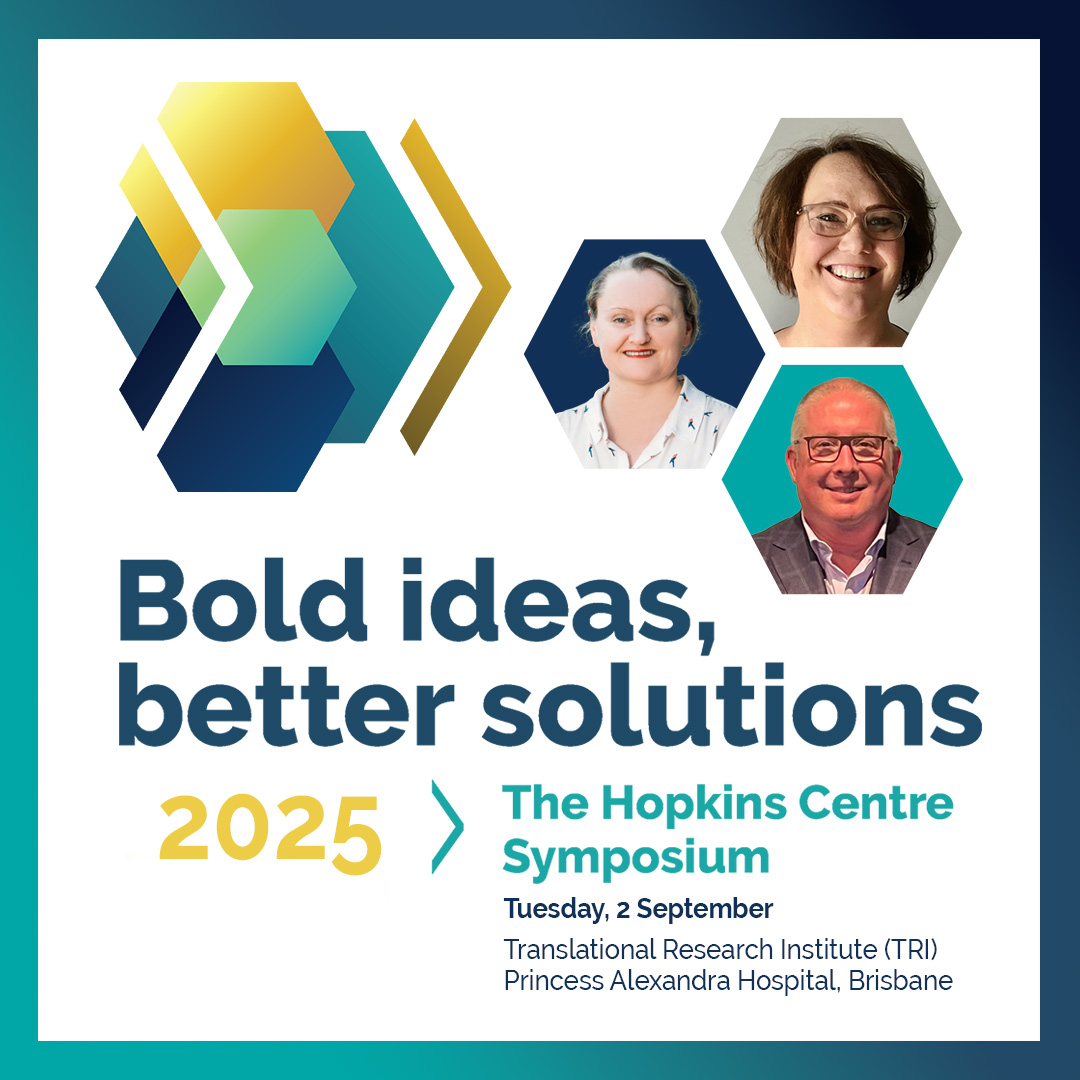
The Hopkins Centre extends its sincere thanks to everyone who attended and participated in the 9th annual Bold Ideas Better Solutions Symposium (#BIBS25) held on Tuesday 2nd September 2025.
During the day we had over 180 delegates in person and live online and along with 37 speakers and 25 research presentations, everyone contributed to creating a very successful hybrid symposium! The Centre thanks our diverse community and membership of clinicians, researchers, service users, citizens and industry partners, who collectively enriched the discussions and presentations around this year’s theme of Identity and Participation.
The day-long symposium focused on Hopkins model of ‘close to practice’, translational research, which brings together clinicians, researchers, service users, consumers and industry representatives in meaningful research partnerships, to exchange new ideas and spark innovative solutions for the future.
Presentations from lived experience experts, clinicians, and academic researchers on diverse topics including transport equity, sleep, friendships, technology innovations in rehabilitation, inclusive environments, pain management, rehabilitation trajectories, highlighted the value of co-designed, inclusive and engaged research, to enhance the health and wellbeing of people with disability and complex rehabilitation needs, and their support networks.
You can revisit key aspects of the symposium at the following links:
Symposium resources
Presentations and recording
Symposium summary newsletter
We hope you enhanced your knowledge as well as enjoyed key features of the day including:
- Official welcome speech by Ms Gaenor Walker, General Manager the National Injury Insurance Scheme Queensland Agency, our primary funding partner;
- Dr Lisa Stafford’s engaging presentation on transport equity and why some trips are not made and what we can do about it;
- Keynote presentation by Emeritus Professor Jacinta Douglas, reinforcing the importance of social communication for identity and participation after injury;
- A thought provoking lived experience panel, sharing valuable perspectives of participation on identity;
- Presentations by 37 different speakers on an broad array of interdisciplinary research topics and Hopkins clinical research fellowships and seed grants, focused on translating bold ideas into better solutions for the future;
- Experiencing a snapshot of the innovative NeuroRhythm Program, connecting people with brain injury through rhythm, drumming and music. You can see more if you Check out the mini documentary; and
- Poster Displays showcasing research endeavours from across the Centre and partner organisations.
For those who missed out on attending or tuning-in online, copies of event proceedings, presentations and electronic versions of research posters are now available on The Hopkins Centre website, here.
If you had to leave early, you may have missed the announcement of this year’s Hopkins Centre Research Award winners! These annual Hopkins Centre Research Awards recognise the outstanding contributions of Hopkins members, researchers, and clinicians. Congratulations to our award winners:
- Emerging Researcher award – Kristin Tynan
- Research impact award – Dr Michael Norwood
- Early Career Researcher & Citizen Researcher Award: Dr Emily Bray
- Early Career Researcher Award - Dr Christy Hogan
- Sustained Contribution Award: Kylie Pershouse
- Sustained Contribution Award: Janelle Griffin
Once again, thank you for being part of #BIBS25. We are grateful to everyone who attended and were involved in the symposium, exploring bold ideas that are being translated into better solutions for the future. Your commitment to advancing research, innovation, and collaboration in the disability and rehabilitation sector is truly commendable. We look forward to your continued engagement, research interest and future collaboration.
Also, let’s not forget that its Spinal Cord Injury Awareness Week (SCIAW 2025) this week – look out for more from us through out rest of the week.
To stay up to date on The Hopkins Centre, research and events, via our website, THC Wrap up newsletter, events and follow us on socials.
If you have any queries, please contact The Hopkins Centre at hopkinscentre@griffith.edu.au.
Speakers
|
Keynote Speaker: Jacinta is Professor Emeritus and holds the Summer Foundation Research Chair on Living Well with Brain Injury in the Living with Disability Research Centre at La Trobe University, in Melbourne, Australia. She has qualifications in the disciplines of speech pathology and clinical neuropsychology and has extensive research and clinical experience in the rehabilitation of adults with acquired brain injury. Jacinta is a Fellow of the Australasian Society for the Study of Brain Impairment and the Speech Pathology Association of Australia. She has authored more than 220 peer reviewed journal publications and 14 book chapters and has delivered numerous keynote and invited presentations and professional workshops nationally and internationally. |
|
Associate Professor Melissa Kendall
|
|
|
|
|
|
|
|
|
|
Izak Hollins
|
|
Hannah is a lived experience researcher and PhD student with an Honours degree in Biology. She has lived with a complete spinal cord injury for 24 years and has had experience within the paediatric and adult health systems within Queesland. Her PhD currently investigating access to social inclusion and leisure for people with a disability. Hannah has previously worked in disability inclusion programs, being selected to take part in Brisbane City Councils Disability Action at Work program in 2018, where she was able to interact with fellow lived experience graduates navigating accessible work places. Hannah currently works as a researcher for the Hopkins Centre at Griffith University, assisting in two ongoing seed grants. This research includes utilising new technologies for home modification practice for people with a spinal cord injury and understanding the importance of hospital room personalisation in the rehabilitation of people with a brain injury. Hannah also previously worked on projects relating to public transport access and lived experience co-design of tertiary health education. She also co-teches at Nathan Campus for a third year Occupational Therapy subject. As well as being apart of the Inclusive Futures: Reimagining Disability program and an ambassador of the Hopkins Centre. |
|
|
|
|
|
|
|
The Clinical Fellowship is currently affording Emily the opportunity to (a) conduct a national benchmarking survey on dashboard use in SCI services, (b) conduct a scoping review investigating factors that impact dashboards usefulness, usability and utilisation in healthcare, (c) conducting focus group interviews with QSCIS clinicans to gain deeper insights into how and why clinicians would utilise data in clinical practice and (d) leveraging these findings to build a prototype dashboard for QSCIS clinicians. |
|
|
|
Rachel has been an Occupational Therapist for 25 years and has worked at the junction of individual clinical needs within the context of service delivery models of these statewide schemes responsible for funding assistive technology and other treatment, care and support for Queenslanders. Shehas contributed to a number of Hopkins Centre projects researching assistive technology use and the transition from hospital to home. |
|
Kelsey is a Research Fellow and the research lead of The Dignity Project Flagship program at The Hopkins Centre. She is also the lead researcher on a new collaboration with the Department of Transport and Main Roads. Kelsey specialises in human rights research, disabilty research and rights, critical disability theory, and dignity theory. She has extensive experience in ethics, governance, and data management and security as well as supporting fellow researchers in project and research management. |
|
|
|
Matt McShane is a two-time Paralympian and Project Coordinator of Disability Design at Griffith Inclusive Futures: Reimagining Disability. He is an Industrial Designer and creator of the Design Café, which received Seed Grant funding from The Hopkins Centre earlier this year. Matt is passionate about co-design of assistive technology (AT) with end-users with disability. |
|
Glenn is a physiotherapist by background and has spent the past six years working on projects aimed at improving care for people with spinal cord injury (SCI) and acquired brain injury (ABI). He is currently the Project Manager of the Aus-InSCI Translation Project. |
|
Catherine Cave is a Senior Physiotherapist who has worked in the Brain Injury Rehabilitation Service at Princess Alexandra Hospital for the past 16 years. Where she has developed her special interest and clinical expertise in brain injury rehabilitation and hypertonicity management. Her current role as the Clinical Research Officer for the Queensland Multidisciplinary Hypertonicity service involves leadership of the current Hopkins seed grant funded translational research project and establishing and coordinating research with Industry representatives. She holds an Adjunct Research Fellow Position with Griffith University. |
|
Dr. Kylie Ferguson is a Rehabilitation Medicine Physician focused on improving the independence and quality of life of people with disabilities. She works at Princess Alexandra Hospital and West Moreton Health Service, providing rural rehabilitation at Boonah Hospital and also serves as a Visiting Medical Officer at St Andrew’s Ipswich Hospital. Specializing in neurology with a focus on brain injuries, she holds a master’s in Speech Pathology and later completed her medical degree, specializing in Rehabilitation Medicine. Dr. Ferguson also supervises trainees and serves as an examiner in her field. |
|
|
|
Kelly Clanchy is a Senior Lecturer and Program Director for the Bachelor of Clinical Exercise Physiology, School of Health Sciences and Social Work, Griffith University, and a mid-career researcher. Kelly received her PhD from the University of Queensland with her project relating to the promotion of physical activity participation in individuals with brain impairment. Her primary research area relates to the use of evidence-based, stage matched strategies for the promotion of physical activity participation and community integration for individuals with a disability. Additional research areas also include measurement and mediators of physical activity participation, and the co-design of technologies and interventions to improve practitioner and patient outcomes in rehabilitation. |
|
Dr Tenelle Hodson is an occupational therapy lecturer with a strong research interest in the sustainability of healthcare services, inclusive of economic, social, and environmental sustainability. Much of her research has focused on the lived experiences of people with illness and disability, particularly neurological conditions and injuries, in order to better understand what is required from services in order to meet needs. |
|
Danielle is a Senior Research Assistant and PhD candidate with Griffith University. Her research focuses on promoting positive environments for individuals with neurological injury to enhance wellbeing, foster engagement, and expand opportunities for participation. Danielle is in the third year of her PhD. As part of her doctoral research, she developed a co-designed movement and mindfulness program in partnership with an interdisciplinary team of researchers, medical professionals, allied health practitioners, and dance educators. This program was trialled within an inpatient neurological rehabilitation setting, aiming to support wellbeing through creative and embodied practices. She also contributed to a research project that aimed to understand if, how, and why inpatients in neurorehabilitation personalised and/or modified their room environment. In addition to her academic work, she was a content creator and facilitator of NeuroRhythm – a djembe drumming and rhythm program specifically designed for individuals with neurological disorders. |
