

Seeing home differently: 3D technology could transform home modification planning
A new publication from Hopkins Centre researchers is exploring how three-dimensional (3D) visualisation could help make home modification planning more collaborative, accessible and responsive to the needs of people with spinal cord injury (SCI).
Published in Disability and Rehabilitation: Assistive Technology, the study, “Three-dimensional visualisation of activities of daily living for home modification planning (VisADLs) after spinal cord injury: stakeholder perspectives from a qualitative proof-of-concept study”, examines the potential of using motion capture and 3D visualisation to represent how people move and interact with their home environments. 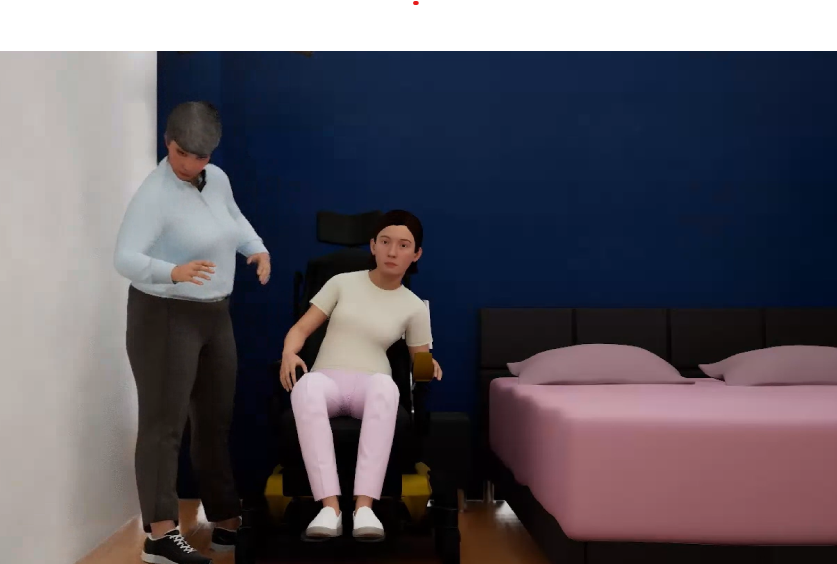
The publication is an outcome of the Hopkins Centre Seed Grant project “Can we enhance the home modification process and outcomes using 3D visualisations of activities of daily living (ADLs)?”. The project aimed to develop a prototype tool that could visually represent the complex interactions between a person, their mobility equipment, other people providing physical support, and the built environment.
Creating a clearer picture of life at home
Home modifications can play an important role in supporting independence, safety and participation for people with disability. However, planning modifications can be complex, particularly when there are limited opportunities for a person to physically access a home or participate fully in design decisions.
The research team explored whether 3D visualisations based on the real movements of people with SCI could provide a shared way for people with lived experience, occupational therapists, builders and funding assessors to better understand how a proposed environment might work in practice.
The proof-of-concept study involved 12 stakeholders, including four people with SCI who had experience with home modifications and eight occupational therapists. Participants viewed a prototype tool showing activities of daily living captured through motion capture technology and discussed its potential uses, design requirements and feasibility in clinical practice.
Supporting more informed and collaborative decisions
Participants identified several potential benefits of the technology. The visualisations were seen to help reduce uncertainty about how people, equipment and spaces interact, support greater participation in decision making, and improve communication between people with SCI and the professionals involved in planning and delivering home modifications.
Importantly, participants highlighted that realistic representation matters. Using motion capture based on the movements of people with lived experience was considered important for creating respectful and authentic representations of disability. The research also highlighted the need for the technology to accurately capture the functional details that can affect everyday activities, while remaining flexible enough to accommodate individual differences in movement, equipment and support needs.
For the technology to be useful in practice, participants also emphasised the importance of integrating it into existing clinical tools and workflows.
From seed funding to research impact
The publication demonstrates how Hopkins Centre Seed Grants can help researchers develop and test new ideas that have the potential to improve rehabilitation practice and outcomes.
The original project brought together researchers and collaborators across rehabilitation, occupational therapy, design and technology, with people with lived experience of disability involved in developing and testing the concept.
While further research and development is needed before 3D visualisation can be routinely used in home modification planning, the findings suggest the technology could provide a valuable shared reference point for understanding the lived experience of disability within the home environment.
Publication
Walker, J., Gustafsson, L., Simmonds, H., McShane, M., Ditcham, R., & Della-Bosca, D. (2026). Three-dimensional visualisation of activities of daily living for home modification planning (VisADLs) after spinal cord injury: stakeholder perspectives from a qualitative proof-of-concept study. Disability and Rehabilitation: Assistive Technology, 1–19. DOI: 10.1080/17483107.2026.2717486.
Tags: VisADLs, SCI, Spinal Cord Injury, #D Technology, Home Modification
Related Articles
- World-leading centre for rehabilitation and disability research opens
- Making breathing easier for patients with acute spinal cord injury
- Singing as a form of rehabilitation
- Spinal Cord Injury Management Course - POSTPONED
- Media Release - Launch of The Dignity Project Citizen Science Initiative
